Trending

The first time you plant lavender in a cold, rain-fed garden, you learn the difference between a style and a climate. The look that reads as Mediterranean — silver leaves, warm stone, clipped evergreens, a vine throwing shade onto gravel — can certainly be built in a cooler, wetter place. It just cannot be copied plant for plant. What travels well is the logic: sharp drainage, lean soil, shelter, and hard surfaces that hold the day's heat. What travels badly is the assumption that lavender, cistus and olive will shrug off a wet winter and a slow spring. Get those two things right and the rest of the style follows quite naturally.
Mediterranean gardens are shaped by drought. Rain arrives in winter, the soil dries by early summer, and the sun is fierce for months. Plants have adapted to that rhythm: small or grey leaves, deep roots, and a habit of going quiet in August. A cool, wet climate runs an entirely different programme. Rain falls through the year, light levels are softer, and ground can stay cold and heavy well into spring. Roots rot here rather than bake.
Two rules follow. First, water has to leave the garden faster than it arrives. Second, most of the plants you want need more sun and warmth than an average border offers. That means editing. One sheltered, sunny corner planted properly will read as more convincingly Mediterranean than a whole garden spread thinly. Find the south- or west-facing wall, the slope that drains, the paved area that throws back heat — and concentrate your effort there. A scented path to a bench under a vine is worth more than an ambitious parterre that sulks all summer.
The most useful job you can do in a cool-climate Mediterranean garden is raise the root zone. Lavender, rosemary, thyme, cistus, santolina and sage all come from rocky hillsides and detest sitting in wet soil over winter. On heavy clay, a raised bed 30 to 40cm deep filled with a gritty mix will succeed where the same plants fail in open ground.
Water new plantings through their first summer, then leave them to it. Little-and-often watering encourages shallow roots and does more harm than good once a plant is established.
Choose by foliage first. The silver and grey leaves are the signature of the style, and they carry it through the weeks when nothing is flowering. Scent matters almost as much: brush past a rosemary or a thyme on a warm evening and the whole garden feels a climate zone further south.
Figs, bay, myrtle, strawberry tree and olives all do best with the reflected heat of a south-facing wall and sharp drainage at the root. Wisteria, grapevines and a tough climbing rose will furnish a pergola in almost any climate, provided the frame is strong and the pruning is kept up. In cold districts, treat tender favourites as pot plants and move them under the eaves or into a shed for the worst weeks. It is more honest than watching them die slowly in the border.
Materials do half the styling, and in a cool climate they do practical work as well. A brick or stone wall facing the sun stores heat through the day and releases it at night — a few degrees of protection, which is often enough to bring a marginal plant through. Pale limestone, sandstone, warm brick or lime render in an ochre tone all raise the perceived temperature and bounce light back into the border.
Construction details matter more here than in the south. Use lime mortar rather than hard cement on older stone and brick; it flexes with movement and lets moisture escape. Slope copings very slightly so water runs off rather than pooling. Frost damage comes from saturated stone freezing, so choose dense, frost-resistant material for steps and copings and keep them out of the constant drip line of roof and trees.
A gravel terrace is cheaper than paving, drains instantly and sounds good underfoot. Lay it over a compacted base and a weed membrane, at 5 to 7cm deep. Wide, shallow steps are kinder than steep ones, and a low wall you can sit on will be used far more than an extra metre of planting.
Shelter is not a decorative extra in a cool climate; it is what makes the garden usable and keeps plants alive. Wind does more damage than cold, stripping moisture from leaves in winter when roots are too cold to replace it. A simple open pergola over a gravel terrace, clothed in vine or wisteria, creates a warm, still pocket and gives you somewhere to sit from April onward. Keep the roof open — solid cover blocks the light and the rain you actually want.
For walls and partitions, use clipped evergreens: yew where drainage is decent, hornbeam on heavier ground, and low hedging at 60 to 90cm so light still reaches the beds. Box is beautiful and increasingly risky where blight is present; Japanese holly, euonymus, lonicera and small pittosporum are useful stand-ins. Slatted timber screens that filter around half the wind work better than solid fences, which simply push turbulence over the top and down into the border.
Small enclosed spaces warm up faster than open ones, so dividing the garden pays twice: you gain rooms, and each room gains a marginally kinder climate.
The garden has to look like something in February. Clipped domes, bare branches, stone, gravel and dark evergreen give it shape when everything else has collapsed. Resist the urge to cut everything down in autumn; seedheads and stems hold structure and shelter insects until spring.
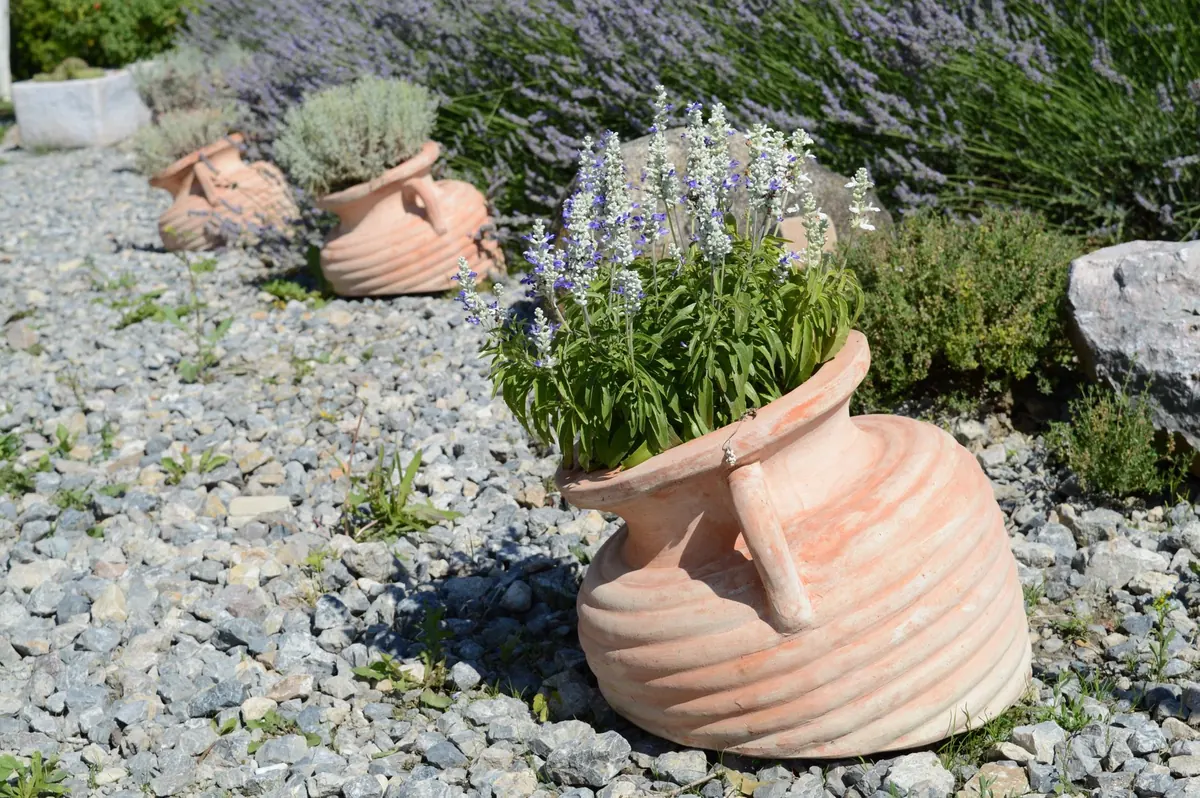
Pots are a gift in cooler climates, but ordinary terracotta can crack once it is saturated and frozen. Use frost-resistant or glazed containers, raise them on feet, add a generous layer of grit at the base, and group them against a wall or move them under the eaves for the wettest months. A large pot holds its root ball warmer than a small one, so go bigger than feels sensible.
A Mediterranean garden in a cool place will never be Provence, and it should not try to be. But warmth, scent, a dry place to sit out of the wind and the sound of gravel underfoot are achievable almost anywhere — provided you start with the soil and the shelter, and let the plants follow.
Photo: Onkel Ramirez / Pexels